
Thriving disc golf leagues are vital to healthy disc golf communities. They keep longtime players motivated to play regularly, give beginners a chance to deepen their interest in the game, and help everyone widen their circle of friends.
While participants meeting up each week to play what's essentially a semi-formal tournament round is the current norm for disc golf leagues, that model is far from the only option.

Here you can explore alternative disc golf league formats being used around the world that have successfully attracted players from wide ranges of age and experience levels. Whether you're a veteran league director or just starting out, one of these ideas could spark something that lights a new fire in your disc golf community.
We've also included some basic information about disc golf leagues to help newer organizers with pressing questions. The navigation below makes it easy to hop to the information you're most interested in with just a tap or a click.
Post Navigation
- What is a disc golf league?
- What are the best days & times for a disc golf league?
- Do disc golf leagues need to cost money?
- What's the easiest way to keep score & standings for disc golf leagues?
- What are the best ways to advertise a disc golf league?
- Disc golf leagues with handicap scoring
Fun for all ages & experience levels - Doubles disc golf leagues
Play with teammates – make new friends, learn new things - Non-competitive disc golf leagues
Create a regular time for disc golfers to simply enjoy the game together
Disc golf leagues for specific groups
- Learning disc golf leagues
Excite & teach beginners - Women's disc golf leagues
Spaces where women can feel at ease playing, learning, & bringing their friends to try out the game - Disc golf leagues with a purpose
Whether to help people cope & learn about mental health or giving members of at-risk communities a way to feel seen and supported, disc golf leagues can be about much more than just a game
Disc golf leagues that expand when people can play
- Glow disc golf leagues
Play after the sun goes down (great during those short winter daylight hours) - Flex start disc golf leagues
Play after the sun goes down (great during those short winter daylight hours) - Weekday morning disc golf leagues
Plenty of people don't work weekday 9 to 5s. Give them a chance to meet other disc golfers, too.
Disc Golf League Basics
Interested in starting a disc golf league but want some direction on starting off on the right foot? Find it in the sections below:
- What is a disc golf league?
- What are the best days & times for a disc golf league?
- Do disc golf leagues need to cost money?
- What's the easiest way to keep score & standings for disc golf leagues?
- What are the best ways to advertise a disc golf league?
What Is a Disc Golf League?
Disc golf leagues are a series of regularly-scheduled events that give players a good reason to meet up and enjoy the game together. A single event in a league series is usually just one round.
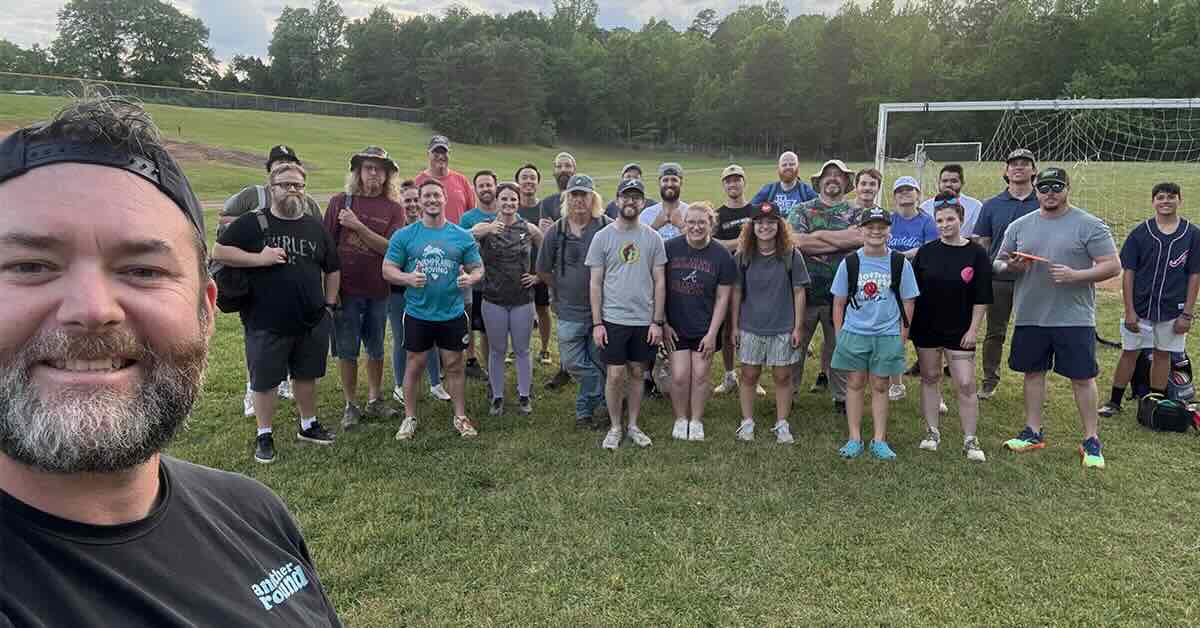
Two other common names for disc golf leagues are "minis" or "weeklies" (though there's no reason leagues can't happen bi-weekly, monthly, etc.).
While many disc golf leagues are competitive and ask participants to meet on a single day at a specific time, that's not always the case. Some leagues allow participants to play at times convenient to them throughout a day, a week, or an even broader period. There are also non-competitive leagues aimed more at building and maintaining local disc golf communities.
When Are the Best Days & Times for a Disc Golf League?
Disc golf leagues are often scheduled for Monday-Thursday evenings and weekend mornings to avoid times when people are likely to be at work or have other social plans (parties, dinners, date nights, etc. are often on Friday and weekend evenings).
Unless you're planning a flex start league or one specifically for people whose schedules don't follow the 9-to-5 norm, you'll likely want to hold your league within those time frames.
As for exactly what day and time will be best, that will depend on your particular community as well as your own schedule.
Here are important factors when you pick a day/time for a disc golf league:
- Avoid overlapping your event with other local disc golf leagues or regular events. Ask local club leadership or another reliable source if you're unsure when these are.
- Don't pick a time that's likely to be stressful for you. You don't want to burn yourself out just trying to make it to or away from your own league.
- When planning weekday evening leagues, pick a time that will give people a chance to commute to the course from work.
- Consider your community and, if possible, plan around other events that might conflict with league – anything from church services to peak times for popular sports to be on TV.
Once you pick a day and time, make sure to stick with it so people will feel comfortable planning it into their regular schedule.
Do Disc Golf Leagues Need to Cost Money?
Disc golf leagues can absolutely be free. In fact, it removes a barrier that could stop some people from becoming more involved in the disc golf community.
Registration and scoring for disc golf leagues can be done electronically at no cost to players or league directors, so there's no need to spend money on paper scorecards and pens/pencils. Similarly, you can advertise disc golf leagues effectively purely through digital sources.
Of course, entry fees can be useful for league organizers to purchase prizes, make print advertising (e.g., posters, flyers), or use in other ways to promote and liven up the league. When a league does take entry fees, it's important for it to be transparent with participants about how much it takes in each week and what those fees go to.
What's the Easiest Way to Keep Scores & Standings for Disc Golf Leagues?
UDisc Leagues takes care of registration, creating playing groups, real-time scoring and leaderboards, overall league standings, and more for free. The free version of the UDisc app is the only thing players and organizers need.
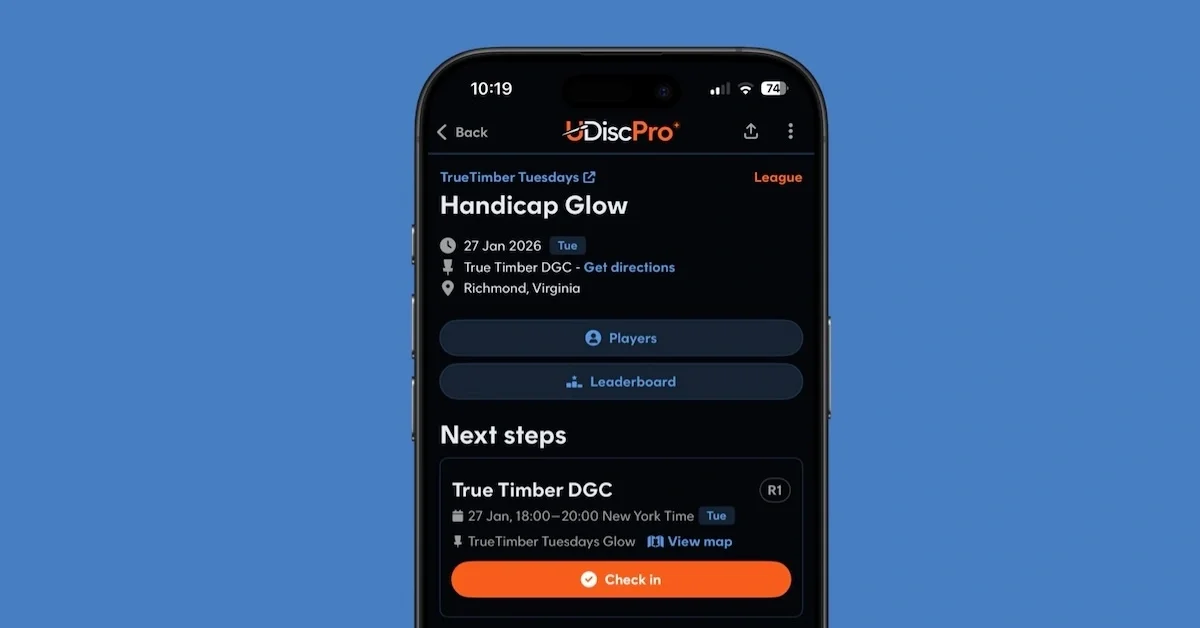
Another perk is that players checking out a course on UDisc can see league events, letting them know they can join in on the fun or avoid the busier-than-usual course.
UDisc Leagues supports doubles and handicap-scored disc golf leagues, too.
Learn more about this easy and free way to run a disc golf league in detail in our UDisc Leagues overview.
What Are the Best Ways to Advertise a Disc Golf League?
People need to know about a disc golf league to show up to it. Here are some of the best ways to get the word out:
- Social media
Post about your league regularly in local disc golf groups (if one doesn't exist yet, start one so people who see posts elsewhere can join/follow it) and town/city/neighborhood groups. More occasional posts in other local groups with possibly intersecting interests (e.g., groups for outdoor sports like hiking or mountain biking) are also a good idea. - Post at the course
Most disc golf courses will have a central information board, or a convenient place near the first tee, to post information about upcoming events. - Word-of-mouth
If you meet other disc golfers on the course, let them know about the league you're starting up. Encourage other league members to do the same. You never know who you're talking to and who might bring a bunch of friends to try it out. - Local disc golf equipment retailers
Any place that sells disc golf equipment should be happy to advertise a league that will get more people playing the game and maybe shopping in their store for discs and other gear. Take your posters, chat about the league with the staff, and politely see if they have any ideas for spreading the reach of your advertising. - UDisc
UDisc is the most popular app in disc golf, so your event being listed in it can be a powerful form of advertisement. All UDisc Leagues show up on the Events tab of the UDisc app and the online UDisc Events site when people search in the area where they're held. They're also listed on the UDisc page for their host course in the app and on the web. Even if a league is not scored with UDisc, it can be registered as an event on UDisc for free and get these same advantages. - Local online event calendars
Many communities have lists of upcoming activities and events anyone can access, and you should try to get your league on it if it's welcoming to people who've never tried disc golf. Some areas have forms you can fill out digitally with event information. You may have to email or call about the process in others. Search something like "[your town] events" and see what you can find.
Fun Disc Golf League Formats
There are more ways to enjoy disc golf than the traditional single-player-vs.-their-division format. At your disc golf league, players could play in teams, compete fairly without the need for divisions, or even forget the "vs." altogether.
Learn about alternative ways to structure a disc golf league below:
Disc Golf Leagues with Handicap Scoring
Handicap-scored disc golf leagues are a great option if you like the idea of a competitive league that gives truly everyone a real chance to win or place well without the need for divisions.
How Handicap Disc Golf Leagues Work
In handicap leagues, all players get a starting score (AKA, their "handicap") based on their typical performance at league. If a player is expected to score +10 on a certain layout, their handicap would be -10. Someone who's likely to be -2 would start at +2.
These starting scores mean that if someone plays like normal, they should end around par. If they have a good round by their standards, they'll be under par and likely high up on the leaderboard.
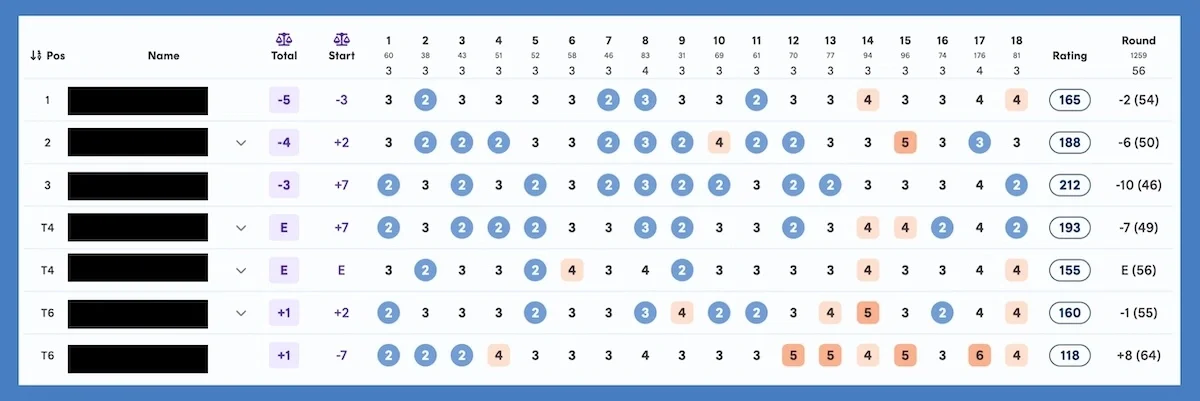
This system makes it fair for people of all ages and abilities to compete together and ensures a variety of winners.
"We didn't see the same names at the top every week," said Mike Batka, who organizes a handicap disc golf league in Wisconsin. "The top spot might be one of the best area disc golfers one week and someone who has only been playing a year or two the next week."
Organizing a Handicap Disc Golf League
Running handicap leagues used to put a lot of work on the organizer. It wasn't easy to calculate scores once league was over or to keep the spreadsheets of handicap data current.
Today, though, UDisc Leagues handles all of that work while organizers can focus on making their events fun and welcoming. With a simple tap or click, any UDisc League can become a handicap league.
Once players have participated in a single round at your league, they'll get a handicap. That handicap automatically recalculates every time they play your league. It also adapts to any layout on any course that is a Smart Layout in UDisc, meaning things stay fair no matter if you change up holes or courses.
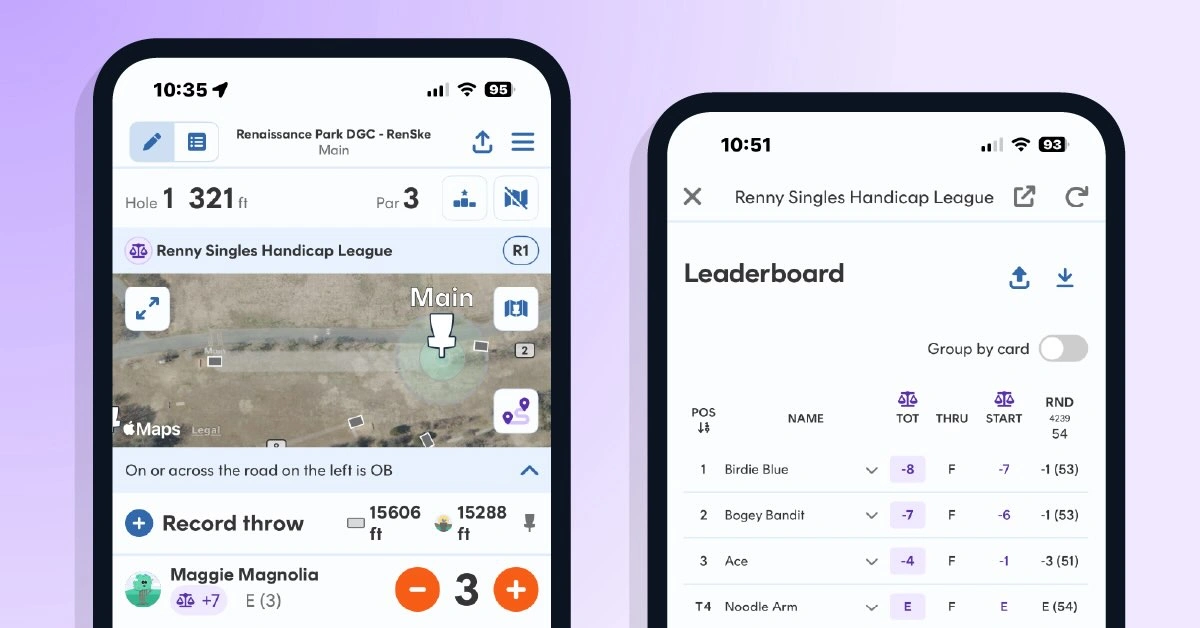
Whether your disc golf community is large or small, handicap leagues provide a way for people to enjoy playing together while focused more on doing their very best than besting their cardmates.
"We wanted to create a league that was cheap, flexible, and competitive to everyone while having no divisions," Ryan Beattie, organizer of a handicap league in Texas, said. "We want everyone to play with, meet, and become friends with everyone else in the club."
To learn more, check out our thorough overview of handicap disc golf leagues.
Doubles Disc Golf Leagues
Playing disc golf with a teammate can help players relax, spend time with new people, and experience the game from a new perspective.
How Doubles Disc Golf Leagues Usually Work
"Doubles" disc golf is when two players take on a course together as a team. At doubles leagues, teammates are usually randomly assigned, two teams make up one card, and "best throw" (AKA, "best disc") rules are followed.
"Best throw" means both teammates throw every shot, and the team can choose which result they'd like to take. If one team member puts their throw in the basket, the other team member doesn't need to throw on that hole anymore.
When an odd number of players show up to a doubles league, there's no need to worry. The most typical solution is to have someone play by themselves but allow them one rethrow per hole (they don't get two tries on every shot because it's way easier to correct your own mistake than for another player to follow a teammates' poor shot with a great one).

The fun of doubles leagues lies in how each league meet-up offers a very different playing experience and the chances they offer people to interact meaningfully with others they may never have met or spent much time with. Doubles leagues also tend to have a more relaxed atmosphere than traditional singles leagues.
To run a doubles league on UDisc, you just need to switch the playing format to "Teams." UDisc can also handle assigning people at random to teams and cards that you can easily publish with a tap on your phone shortly before the league round starts (though you can also assign teams manually if you prefer a different system).
Alternative Doubles Disc Golf Formats
While "best throw" is the most popular format for doubles disc golf leagues, it does have possible downsides. When there's a big disparity between the skill levels of teammates, the less-skilled player could feel like their throws never matter or the more skilled player could get frustrated by never feeling assisted by their teammate.
Some league organizers work around this by having players sign up for different divisions based on skill level, which makes it easier to create fair teams.
Others opt for formats that assure that every player will make consequential throws.
Making a call on a format will hinge on your aims as a league organizer as well as what you think will work in your community. Take a look at "How To Play Disc Golf Doubles: Formats & Tips" for options beyond "best throw" – and don't be scared to think of a creative new doubles format that might work better for the players near you.
Non-Competitive Disc Golf Leagues
Regular disc golf meet-ups can exist purely to create community and not be driven by competition. Pick a day and time, advertise that you'll be at the course with some friends, and invite others to join you.
At these get-togethers, you could keep things interesting by constantly trying out unusual formats, such as…
- Variations of doubles
- Forehand-only drives and upshots
- One-disc rounds
- Swapping bags with another player
- Games like DiscDice (Tip: You can create a similar experience to this game with just pieces of paper with throwing styles on them that players draw out of a bag)
Since there'll be no league standings to worry about, players can enjoy goofy rounds and weird throws without caring too much about their score.
Focusing less on competition is also great for learning leagues that are specifically aimed at people just getting into disc golf. It helps newer players focus on having fun – not comparing their outcomes to others.
Disc Golf Leagues for Specific Groups
Some disc golf leagues focus on particular groups with an eye toward growing the game and/or giving a particular community a place to come together and feel support and companionship.
Learn about a few options for creating leagues with a specific audience in mind:
Learning Disc Golf Leagues
Disc golf leagues designed for and by longtime players sometimes make beginners feel out of place. So if you're interested in seeing your disc golf community grow, it's a great idea to start a league tailored to the abilities and mindsets of newcomers to disc golf.
Creating what he calls a "learning league" was one of the first things Cory Wickline did after opening the disc golf shop Another Round Greenville in South Carolina. His inspiration was a phone call from a newer player. The caller asked for a recommendation for a league to play, and when Wickline suggested a local doubles league, he heard about an unfortunate experience.
"The player said, 'I went to that one, and I'm sure there were nice people there, but I got stuck with a guy who made it very clear that I was not to get in his way,'" said Wickline. "I would say there's a very small percentage of the people who take it that seriously, but he unfortunately got paired with someone who took it very seriously, and that's when he ended up calling me."
Almost immediately, Wickline put together a concept for a league to welcome beginners.
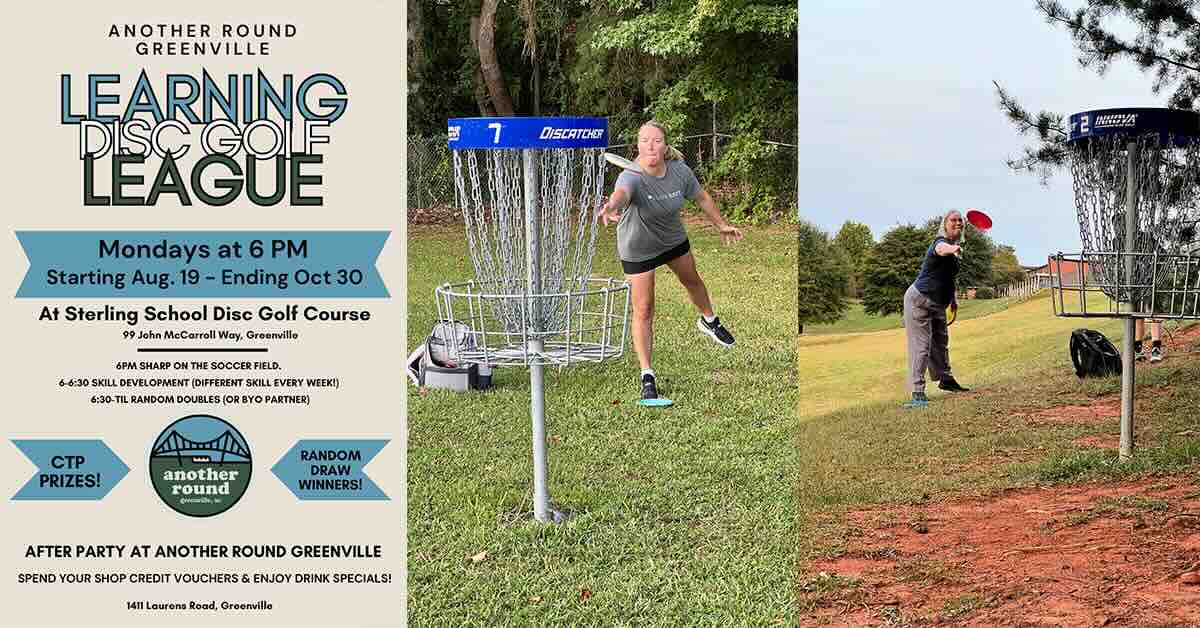
Today, that league regularly takes place at a nine-hole course near his shop with unintimidating hole lengths. He brings a pile of beginner-friendly discs with him to each meet-up and enlists seasoned disc golfers to offer lessons on a basic skill before each league round. Wickline also assures every group has at least one experienced player in it so new players can learn the rules, ask questions, and start their disc golf journey off on the right foot.
Something the shop owner puts no emphasis on, however, is score.
"We don't ask score, we don't care about your score," said Wickline. "We often say 'whoever has the most fun wins' is kind of the tagline of the thing."
Though there's no scoring, smaller games within the game, like CTP (closest-to-pin) prizes and random-draw lotteries for discs to take home, keep things lively and fun.
If you're intrigued by the learning league concept, here are a couple ideas worth chewing on:
- Where to find loaner discs
You'll need a stack of beginner-friendly discs to run this sort of league, but not everyone has a shop to grab from like Wickline. Good sources to ask for donations and/or cheap deals include: Local disc golfers (donating used discs they rarely throw), local disc golf shops or shops that sell disc golf equipment (this sort of league would build their clientele, after all), and disc golf equipment brands. It's possible a local authority (e.g., town council or parks & rec department) might be willing to buy the discs for you, too, if you talk to them about your plans and goals. - Lock in your helpers
If you have a lot of people show up to your learning league, you'll need a few experienced disc golfers to guide them through the course as they play. Make sure you have enough reliable players committed to helping you out so you don't have to choose between forming huge groups (which slow down play and can make the game feel tedious) or holding a "learning league" where some groups don't learn too much. - Consider the cadence
How often you run a learning league will depend on your community. Consider running them in small, limited bursts – such as weekly for a month or two (this is Wickline's strategy) – or more occasionally, like once or twice a month. Developing some regularity so new players have a constant outlet is important, in case they can't make it for a week.
You can also learn more about Wickline's learning disc golf leagues in another Release Point blog post.
Women's Disc Golf Leagues
It's not a secret that far more men currently play disc golf than women, and that imbalance is self-perpetuating.
"The lack of women typically means you'll be throwing in front of men, which can be nerve-racking if you're not super confident in your abilities as a budding disc golfer," former pro disc golfer Sara Sinclair told us for a Release Point post focused on ways to interest more women in disc golf. "The key to solving this particular predicament is to attract enough women to make up all-female cards where women may feel more comfortable. So, it's unfortunately a circular issue: You need more women, but a reason that women may not want to play is because there aren't enough women."
Women's disc golf leagues are one solution to the problem Sinclair described. When all spaces in a league are reserved specifically for women, participants won't have experiences like Nikki Wyatt, founder of the thriving women's disc golf league Chicks Chasing Chains, did when she first started playing disc golf.
"Mixed leagues are fun, but when you're a new girl, it's very intimidating and you don't want to play it," said Wyatt. "[When I was new,] I played somewhere and got paired with some guy for random doubles, and he wasn't in the best mood about it."
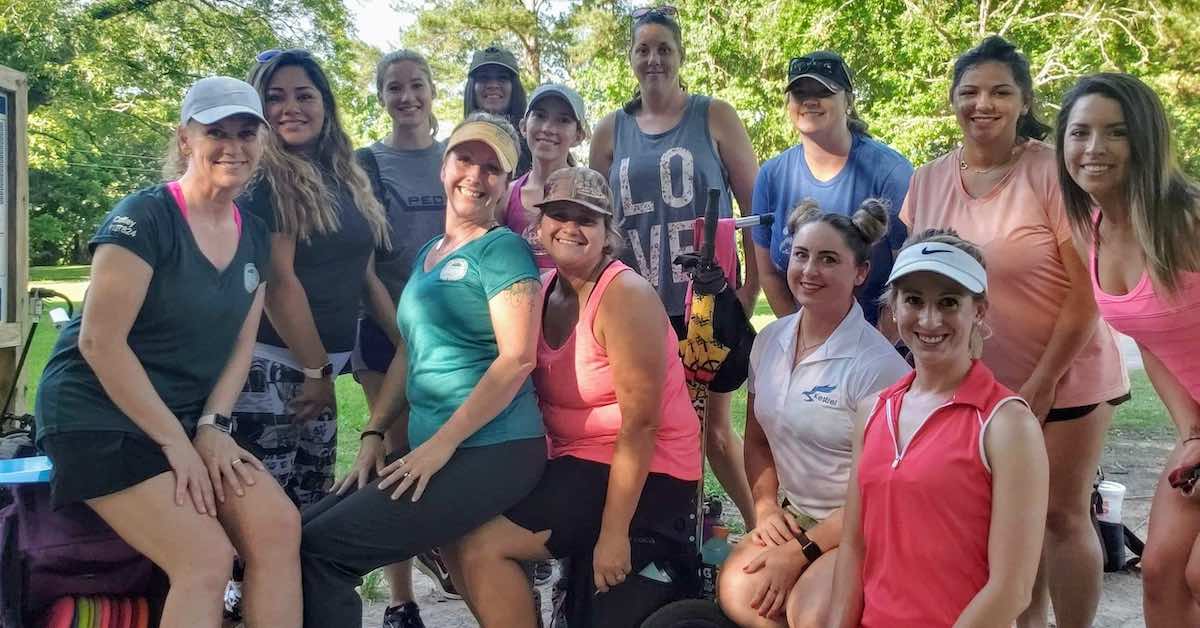
Here are some of the top tips for getting a successful women's league off the ground:
- Beginner-friendly format is likely key
Since one of the ideas behind a women's league is to widen the pool of women disc golfers, a women's league should appeal to players who are interested in trying the sport out for the first time. Options like handicap scoring, a beginner-friendly doubles format, a learning league, or a non-competitive league are all worth considering. These sorts of formats will also mean that if you attract a new player who enjoys herself, she'll feel less awkward inviting non-disc golfing friends to try it out with her next time. - Advertise widely and often
Target every spot where women who might want to try out disc golf are likely to be, whether that's online groups on social media or physical places where you can hang posters. Don't be afraid of initiating in-person invites, either. Wyatt told us that, along with constant online posts, she had an extroverted friend (notably, a woman) who would chase down any woman they saw on the course and hand them a little business card-like advertisement for Chicks Chasing Chains that they kept stacks of in their disc golf bags. - Stay reliable and punctual
Former touring pro disc golfer and now executive director of disc golf non-profit Uplay Zoe AnDyke has also helped organize and lead women's disc golf leagues. She told us that, in her experience, "the biggest deterrent from leagues is when they're not kept on a dependable time structure" because of the difficulties it creates with planning around commitments like family, work, and meals. Make sure you create a league that has an efficient structure and a timeline you can stick to each time it happens. - Be patient
In the early days of her league, Wyatt said she'd often play a round alone after no one showed up at the advertised start time. A women's league will likely take time to grow. As long as you're advertising vigorously, running the league on a dependable schedule, and assuring that everyone who does come feels welcome and has fun, your league should gain a foothold eventually if you stick with it.
To get more advice on this topic from Wyatt and AnDyke, check out the post "Why & How To Start Women's Disc Golf Leagues."
Disc Golf Leagues with a Purpose
If you are part of a community that could use a place to come together and feel supported, a disc golf league can offer just that.
While it's not a league, Andrew GottWorth's international event series called Mental Health Disc Golf offers examples of the game bringing people together to learn, listen, and be heard about a topic many avoid. The events he's organized in Germany, Ireland, and England have had two primary aims.
"One is for disc golfers who may or may not have mental health disorders to learn more about it, start to appreciate what disc golf can bring, and maybe start discussions that break down stigma around mental health disorders," GottWorth said. "The other side is people with mental health disorders who may or may not know disc golf to come into it and maybe find a tool that can help them and then have a space that is stigma-reduced with people talking about mental health – a safer space."
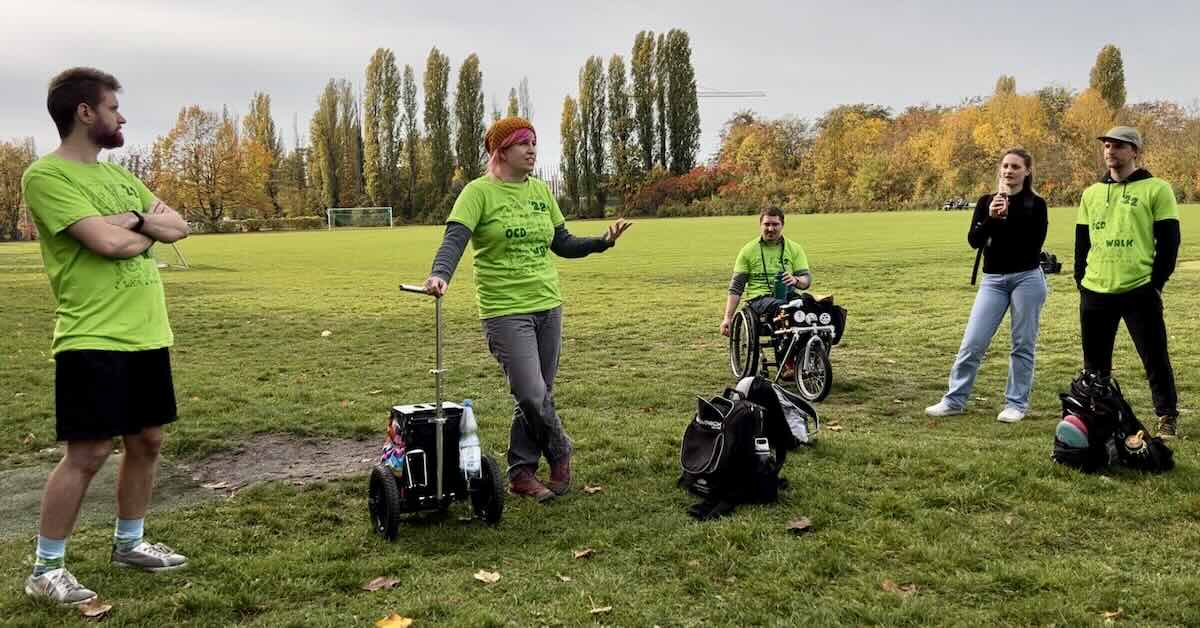
His events are in a doubles format, and each player group has a facilitator who enables conversation around mental health facts or questions as the group plays through the course. You can learn more about the events' structure and results in "Mental Health Disc Golf Events Build Support, Compassion, & Awareness."
Of course, there are plenty of communities other than those struggling with mental health who could use a safer space. Should you want to use disc golf to create one, take some advice Andi Seawright gave us. Seawright is the founder of Queer Disc Golf, an organization "devoted to creating a more accessible, inclusive, and visible space for LGBTQ2S+ individuals within the disc golf community."
"I used to run weekly drop-in groups," said Seawright. "A lot of people would come, and, honestly, they weren't that interested in getting better at disc golf. They were interested in connecting and making friendships. Those tend to be the people who really come to our events. Some are still very good, but they prioritize connection over competition."
Disc Golf Leagues That Expand When People Can Play
Are you interested in disc golf leagues that happen outside of the weekday evening/weekend morning norm? Outside of daylight hours? Or literally almost any time players want? Check out these options:
Glow Disc Golf Leagues
When daylight hours start to dwindle, many weeknight leagues close up shop until the spring. But for glow disc golf leagues, it means peak season has arrived (though some glow leagues go year-round).
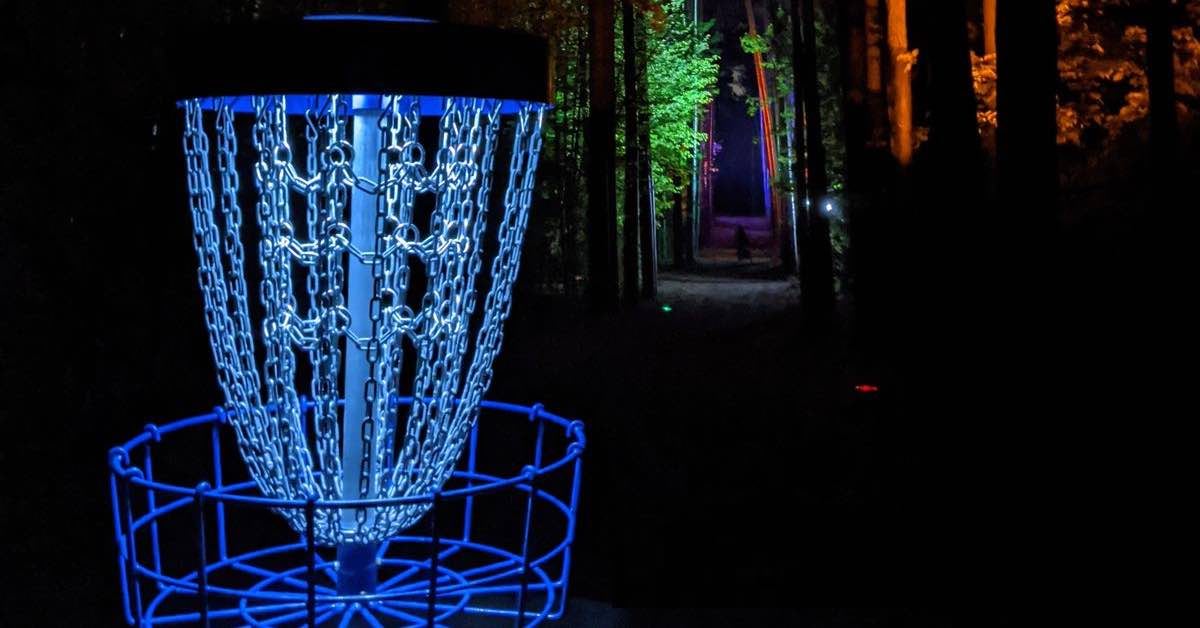
Glow disc golf is a fun way to experience the game even after the sun goes down. Here's how it works:
- Players use glow-in-the-dark discs charged with UV flashlights or normal discs with either small lights taped to them or simple glow tape.
- Targets are made visible with lights designed to fit on disc golf baskets, strategically placed and secured flashlights, or another fairly strong light source.
- Tee areas also need a bit of light so they're easy enough to find in the dark.
Though set-up and breakdown will take a bit more time and players will need more equipment than usual, glow disc golf is an exciting and fun league format that lets people experience the game in an entirely different way.
A former membership coordinator for Denver's Mile High Disc Golf Club, Lauren Johnson, who helped organize area glow events told us this about these nocturnal get-togethers: "Glow disc golf is much more casual than other events we put on. No one is out there to shoot their best shot but rather to have fun playing with different people every week."
Another great thing about glow is that if you've built up momentum with a weekday evening league during the warmer months, you can keep it going by switching over to glow when the time is right.
Learn more about this format in "Glow Disc Golf: How To Play & Stories."
Flex Start Disc Golf Leagues
Flex start leagues offer the chance for participants to play any time they want within a certain time window.
For example, you could make it so that anyone can play your weekly league at any time convenient to them throughout the week. They'd just need to register for the league, log their round as they play, and their score will pop up on the leaderboard after they complete their scorecard.
Monday at 7 p.m.? Fine. Thursday during their lunch break? Tasty. Saturday at 5:30 a.m. to get a jumpstart on their weekend? Not everyone's cup of tea, but more power to 'em.
Windows for competing in a flex start league can be set for virtually any time frame. They also don't rule out the possibility that your league could have an established time when most people play but still allow others who can't make it to the big meet-up a chance to participate.
UDisc Leagues supports flex starts. It takes just a few simple steps during league set-up to make it happen.
Weekday Morning Disc Golf Leagues
Not everyone works weekdays 9-5, and disc golfers who work evenings and weekends often have a hard time finding people to play with or events they can participate in. If you happen to be one of those disc golfers (or someone whose time is more flexible than most), consider starting up a league on weekday mornings to help these players find others who share their schedule.

Cory Wickline, the South Carolina disc golf shop owner we met earlier in the learning leagues section, started up a league that tees at 8:30 a.m. on Tuesdays after he invited two disc golfers who worked at restaurants to play a tournament and neither could because their work schedules conflicted with the competition. So far, it's going well and widening the range of people regularly coming together to play disc golf around his town.
"We normally average about 20 people that come out to that, too," said Wickline. "And that is a completely separate crowd from the people who come out to [our] women's league and a separate crowd from the people that come out to the beginners' league."
Get Your Disc Golf League Started!
Keep in mind that to start a disc golf league, you don't need to be a great player – you just need to be someone who wants to do something great for their community. Check out the options above, think about which ones would best fit or enrich the disc golf scene in your area, and then try your best to make it happen.
You don't need to do it alone, either. UDisc Leagues helps you get your league in front of players and takes care of scoring, live leaderboards, group management, standings, and more – all free for you and anyone who plays your league.
UDisc's mission is to empower the world to play more disc golf. And that means empowering you to create a place where disc golfers can enjoy the best part of the game: Coming together as a community.
